
Saturday, 3 November 2012
Hitchcock on Puns (and youtube)
Well I'm sure journals are on the collective mind, and for those of us writing about Alfred Hitchcock Presents, I'm fairly certain puns are too. Practically every episode I've seen thus far, which is quite a few, has featured some sort of visual or audible pun in the preamble to the narrative made by the master himself. I am often guilty of making terrible puns and laughing at those I encounter, and accordingly a friend sent me this clip to tease me. It's taken from a Dick Cavett interview from 1972; try to appreciate the hilarity of Cavett's hairdo/outfit juxtaposed against Hitchcock's unchanging classic 1950s clean cut style.

Hitchcock
Hey All
Hopefully this isn't a repeated post, but I just watched the trailer for "Hitchcock", coming out later this month. It looks great! I think it'll provide a really interesting perspective of what making a film, especially one as controversial and classic as "Psycho" would be like in the 50s. Also the cast looks stellar - give it a watch!
Hitchcock Trailer
Dishwasher commercial
GE Dishwasher commercial
I was reading random trivia this afternoon and I read that in 1950 GE boasted that its new automatic dishwasher "will give you over 200 long hours of extra leisure time."
I looked it up and I found this ad, which reminded me of the Ozzie and Harriet episode we watched in class a while ago, and our discussion about suburban space and time.
The wife says "we've borrowed dishes from all over the neighbourhood", and towards the end she says of the new dishwasher "No washing for me, no drying for Bill!"
I think this ad exposes the communal suburban ideals of the time-- the camaraderie of familial roles and the sense of belonging in a tight-knit neighbourhood.
Friday, 2 November 2012
Hollywood and Race
Hi guys!
I wanted to get your input on an issue that's kind of been recurring for me ever since the conference presentations on race and the idea of white actors in the 50's playing characters of different ethnicities. Now I think it's fairly undisputed that the production code and American culture in the 50's were pretty racist.. But I remember Louis saying something really interesting in conference about how it's a shame that we see these white actors playing Asian characters and First Nations characters as being racist because as an actor you should be valued for your performance and the importance of an actor is the versatility to become anyone.
I just watched Cloud Atlas ( http://www.youtube.com/watch?v=hWnAqFyaQ5s ) and I thought it was really cool that men played women and women played men and everyone played characters of different ethnicities and I was thinking that maybe this was a sign of greater flexibility and liberalization in our conception of race and "boundaries".
BUT I also just read an article about Zoe Saldana playing Nina Simone in the new biopic and how it is sad that she was chosen to play this amazing woman because it reinforces the white supremacy of Hollywood culture. The writer very eloquently wrote that: "We are expressing our frustration at a racial hierarchy that renders us too unattractive even to represent ourselves. And if we're being honest, you got this role, in part, because of the privilege you've been accorded as a light-skinned Afro-Latina...
you are contributing to the ongoing invisibility of women who cannot remove their deep brown complexions, broad noses, and kinky hair every day after work. This project is a testament to the unconscionable arrogance of white supremacy."
I could use some help thinking through these issues of race depictions in Hollywood and to what extent it has changed since the 50's.
Thursday, 1 November 2012
http://www.azcentral.com/storytellers/video.php?tcat=st-courage,st-inspirational&tname=Growing%20up%20transgender%20in%20the%201950s&vid=937202375001
This is a short video of Millye Carter-Bloodworth, who grew up as a black transgender in the fifties. I thought that this clip was relevant as we've talked about Glen/Glenda, which deals with the sexuality of a white transgender, whereas a film on a person like Millye Carter-Bloodworth would certainly not have been released. I also found this video interesting as it not your typical report on the injustices suffered by individuals who do not fit the hegemonic norm. On the contrary, this is a light, pleasant, inspirational video in which a woman looks back at a hard time in her life and chooses to share the good parts of it, even if they must have been hard to see.
This is a short video of Millye Carter-Bloodworth, who grew up as a black transgender in the fifties. I thought that this clip was relevant as we've talked about Glen/Glenda, which deals with the sexuality of a white transgender, whereas a film on a person like Millye Carter-Bloodworth would certainly not have been released. I also found this video interesting as it not your typical report on the injustices suffered by individuals who do not fit the hegemonic norm. On the contrary, this is a light, pleasant, inspirational video in which a woman looks back at a hard time in her life and chooses to share the good parts of it, even if they must have been hard to see.
Do you have drawers full of batteries?
And you don't know how to get rid of them (because I do!) In my research for my artifact on how science is perceived in the 50's I came across this little picture. In the 50's, batteries were made so that they were disposable.
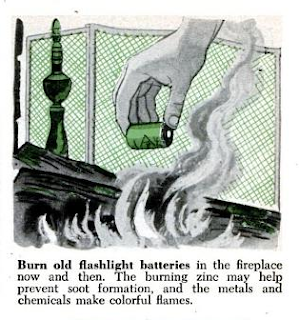

It's interesting to see how the disposability culture in the 50's have transformed into super difficult to dispose of. Nowadays, we have to consider recycling, separating the bottle caps from the bottles because they are made of different materials... as a polymer chemist, I find that disposing batteries by burning them (plus they prevent soot formation!) is much better than purchasing these single-purposed items that we have now and having a hard time ridding them later.
I Love Lucy's Lucy - a complete laughing target for women in the workforce?
I Love Lucy's Lucy - a complete laughing target for women in the workforce?
So, not sure how many people may have seen this episode of I love Lucy, but I'm sure we all have the basic idea of the show, even if just from the episode screened in class. Watching this episode, although super funny, just emphasizes what a joke Lucy is made to be as soon as she tries to do anything in the work force. Throughout the whole episode, her husbandy Ricky makes it clear that she couldn't last a day in the workforce (though he couldn't last in the kitchen either), and when she tries, this is what we see....
Of course, you have to laugh at the ridiculousness... but at the same time, it makes me wonder what it must have been like to be a woman living in this era. She has absolutely no idea how to operate in the workforce and she has no skills that she could apply (and candy-making is probably the closest thing to a kitchen-role). As taboo as divorce was back then, imagine where she'd be if Ricky and her divorced. She'd have nothing to fall back on and would have to pray that her alemony payments were pretty high...
Social Media Ads in the 1950s?
I stumbled upon this a few days ago and I thought if I couldn't share this gem on our blog, wherelse could I share it...? This caught my attention because of its existential, yet realistic element... enjoy and please feel free to share any thoughts or comments... :)
 |
| What Social Media Ads Would Have Looked Like in the 1950s |
Wednesday, 31 October 2012
Happy Halloween!
As I'm sitting in the library wishing that I could go trick-or-treating, I started to wonder what the actual history of Halloween entailed, and how it traced from its beginnings to the commercial celebration as we see it today. Granted, the History Channel isn't always the most legitimate authority on every topic (Ancient Aliens comes to mind) but it did bring up some interesting points and some of the attached video clips are worth while. I never considered the history of trick-or-treating; I found the revival of trick-or-treating in the 50s and the correlation the article draws between it and the Baby Boom very interesting.
Happy Halloween again everyone! Be sure to eat lots of candy in memory of our childhoods.
The History of Halloween
Happy Halloween again everyone! Be sure to eat lots of candy in memory of our childhoods.
The History of Halloween
Happy Halloween: the Mr. Rogers Edition

Mr. Rogers is a very prominent figure in my childhood, and after I did a little research I found that he was actually active during the 50's. It's interesting, but I don't think I've seen anyone dressing up as Mr. Rogers for Halloween, and yet you can see a skankified version of almost everything (I saw costumes for My Little Pony). Anyone dressing up as Mr. Rogers this year?
I wonder whether his trolley played a social commentary on urbanization. Hmm...
Who is Long Tall Sally?
Our conversation in class today about Glen or Glenda reminded me of Little Richard's 1956 hit Long Tall Sally. The lyrics of this song, when read critically, seem to allude to Long Tall Sally possibly being a man or a transvestite, for example, "Long Tall Sally, she's built for speed/ she got everything that Uncle John need." This line makes me question what Long Tall Sally has that Aunt Mary doesn't.
Here are the lyrics :
I'm gonna tell Aunt Mary about Uncle John
He claims he has the music, but he has a lot of fun
Oh baby, yes, baby
Ooh baby, havin' me some fun tonight, yeah
Well, long tall Sally, she's built for speed
She got everything that Uncle John need
Oh baby, yes, baby
Ooh baby, havin' me some fun tonight, yeah
Well, I saw Uncle John with bald head Sally
He saw Aunt Mary comin' and he ducked back in the alley
Oh baby, yes, baby
Ooh baby, havin' me some fun tonight, yeah
Well, long tall Sally, she's built for speed
She got everything that Uncle John needs
Oh baby, yes, baby
Ooh baby, havin' me some fun tonight, yeah
Well, I saw Uncle John with bald head Sally
He saw Aunt Mary comin' and he ducked back in the alley
Oh baby, yes, baby
Ooh baby, havin' me some fun tonight, yeah
We're gonna have some fun tonight
We're gonna have some fun tonight
Ooh, Have some fun tonight
Every thing's all right
Have some fun
Have me some fun tonight
Also, feel free to laugh at the awkward clapping white people in the video, they look so dorky compared to Little Richard and his band.
Tuesday, 30 October 2012
More 50's Halloween Fun!
Here's another spooky rock 'n' roll song, this one featuring shrieking wind, screaming, and evil laughter for your listening delight!
And a couple fun images. I love the flat, cut-out style of the first one.


Bo Diddley - Bo meets The Monster
Tomorrow's Halloween, and as I was working on my journals and doing some research on 1950's music, I came across this song, "Bo Meets the Monster" from 1958, by Bo Diddley. From my understanding, it was played at Halloween parties back in the day... Happy Halloween everyone!
Reminder: "Office" Hours Today
Hi everyone,
Just a reminder that I'm holding some office hours in the library today from 2-5pm. I'll be over in the new study area (where the circulation desk used to be).
I'm holding these hours today, because I am leaving for Austin early Thursday morning to attend an academic conference. So we will not be meeting for our conferences this week, nor will I have by usual Thursday office hours. I'll still be available on e-mail, but I likely won't be able to respond as quickly or at as much length as usual.
Cheers,
Casey
James Dean as a cult figure
I took a class last semester called Consumer Behavior. One
thing we discussed was celebrities. In once class, the prof said: “The best
thing Michael Jackson did to keep his legacy alive was to die a sudden death at
a young age. If Madonna wants people to remember her, the best thing she could
do right now is to just die.” It’s kinda funny to hear someone say that, but
there’s also some truth to it. Which makes me wonder: had James Dean not gotten
into a car accident and died at the young age of 24, would anyone have talked
about him today? Is the fact that he died so young and that we think his death
robbed us of the many more great works he could’ve made make it a lot more
dramatic?
When I think about it, it makes sense: when celebrities age,
they become less and less important. Their “star” factor fades and the world
slowly starts to forget how admired they once were in their glory days. So
losing them at an old age doesn’t have a shock factor to it, but losing a
celebrity in his prime, in his golden years, when he or she still has potential
to wow us, then that can be dramatic to us. We will then remember what great works
this celebrity did in his short-lived life and be marked by the tragedy.
There are very few celebrities who have the ability to stay in the
spotlight throughout their entire lives. All celebrities are like perishables;
they all have an expiration date. There are very few I can think of who stayed
in Hollywood for a long period of time. Meryl Streep and Betty White are examples.
Can anyone think of other stars who managed to stay famous for a long time?
[Note: this is just about stars, so directors such as Hitchcock or Spielberg do
not count.] And does anyone have any thoughts about this?
Happy Halloween, from the 1950s to you

Kind of creepy right? I like how the one pumpkin head is holding back the cat so the other pumpkin head can pumpkin head him. And check out the pumpkin head in the back, they look like they're telling the cat "it's okay" because he's next in line to get pumpkin headed. I also find it funny how the cat pumpkin heads only have cut out faces but the humans have real faces on the pumpkins.
Happy Halloween, straight from the 1950s.
Monday, 29 October 2012
Invasion of the Body Snatchers
I am so excited for this film!! I'm not sure if many have seen it already, but I genuinely think it is one of the best sci-fi films in the history of cinema (and probably the best of the 50's). It definitely has a bunch of themes which apply to discussions we've been having - loss of autonomy, the possible consequences of the Red Scare and McCarthyism and especially loss of identity. Kevin McCarthy (quite the coincidence) is great - if you've seen Death of a Salesman, you know - and the cinematography is pretty impressive. One thing I wanted to ask you guys (before we view it) - does this film (and these types of films) scare you? Since it's fairly dated, I've never found the movie remotely scary - but I'm sure I would have had a different reaction if I saw it in the 50's. I've found that most thrillers and horrors from this period fail to actually frighten me - Psycho was the closest, though it suffered from my high expectations going into it. It seems that some of the (respectively) funniest, most dramatic, most thrilling and most endearing films came from this era, yet few films can scare the audience the way later cinema was able to (i.e. The Shining or Jaws). Have you guys had similar reactions to sci-fi thrillers and horror films from this era?
Mitt Romney Childhood Photos
Check out this link from LIFE Magazine of Mitt Romney's early years - chronicled because he grew up in a "well-known American family."
It's so crazy to think that before JFK, politicians' lives weren't made into media spectacles that chronicle every detail. However, this feature seems rare to me in that it doesn't seek out controversy or drama in Mitt's background, but rather makes him seem human (?) and emphasizes nostalgia and family values.
Also, the picture of the two men throwing the baby is just hilarious.


Glen or Glenda - Sex Scenes Meaning?
1. I'm curious to understand why Ed Wood is so famous. There are many terrible filmmakers out there and I just don't understand why he stands out from the rest. I read somewhere on the web that Glen or Glenda gained notoriety after having been named the worst film to have ever been made, but that doesn't justify why it's as famous as it is.
2. The second thing I was wondering about was the meaning of the sex scenes in Glen or Glenda. We see two sex scenes: the first one is between a man and a woman (which might also be interpreted as a rape scene), the second one is between two women. I feel that they were a bit out of place in the film and didn't understand how they related to plot in any way. Does anyone have any idea as to why Ed Wood included them in his film?
2. The second thing I was wondering about was the meaning of the sex scenes in Glen or Glenda. We see two sex scenes: the first one is between a man and a woman (which might also be interpreted as a rape scene), the second one is between two women. I feel that they were a bit out of place in the film and didn't understand how they related to plot in any way. Does anyone have any idea as to why Ed Wood included them in his film?
Sunday, 28 October 2012
Reply to Simon's post on "Changing Paradigms"
The most salient example which happened to come across my mind is the portrayal of Sugar Cane in the movie "Some Like It Hot" (Billy Wilder, 1959) starring Marilyn Monroe and the portrayal of Vesper Lynd in the movie "Casino Royale" (Martin Campbell, 2006).
Despite how famous Monroe was during the 50's for being both the "Blonde Bombshell" and the sex symbol of the century, she always played a part for the typical unintelligent yet ingenuous and gullible female figure.
Showing her usual gum-showing smile, Sugar Kane falls for Jerry and Joe's ridiculous disguise without a single moment of doubt. Her imbecility makes it convenient for the two male leads, allowing the film's plot to develop into a more intriguing stage. Like the first two posters in the post above, the representation of women in the 50's often incorporates the woman in male grasp. Even in "Some Like It Hot", in the beginning part of the movie, Sugar Kane explains her determination not to fall in love ever again, for she was only left with the "fuzzy end of the lollipop" by the cruelty of her past lover. This reference makes it clear how easily the female roles were defined and swayed by the male influence.

Nevertheless, Vesper Lynd in the movie "Casino Royale" starring Eva Greene, makes a great epitome for an intellectual, stubborn, confident, and independent from the male superiors. When having dinner with James Bond on their way to Montenegro, here's their conversation about Bond's first impression on Vesper:
Vesper: Which one can say of any attractive woman with half a brain.
Bond: Tue, but this one overcompensates by wearing slightly masculine clothing and being more aggressive than her female colleagues, which gives her a somewhat prickly demeanor and, ironically, makes her less likely to be accepted and promoted by her male superiors, who mistake her insecurity for arrogance. I would normally have said only child, but by the way you ignored the quip about your name and your parents I would go with orphan?

Unlike Sugar Kane, Vesper Lynd is depicted as a woman with brain, having her own career as a successful accountant, and often wittily shoots back at Bond's naughty jokes with prudishness. From the portrayal of Lynd, the viewers could draw a distinct comparison between the "old women" and the "new", for nowadays female roles palpably contain influence just as significant as male leads.

(Look at that grin.....it's the one of a winner. She's the winner.)
They are never afraid to speak up for themselves, and furthermore, even throws a naughtier joke to make their male partner take aback. Here's the rest of the conversation:
Vesper: All right….by the cut of your suit you went to Oxford or wherever and actually think human beings dress like that. But you wear it with such disdain, that my guess is you didn’t come from money and all your school chums rubbed that in your face every day, which means you were at that school by the grace of someone else’s charity, hence the chip on your shoulder. And since your first thought about me ran to orphan, that what I’d say you are. sees a slight reaction. Oh you are. And it makes sense since MI6 looks for maladjusted young men who’d give little thought to sacrificing others in others to protect queen and country. You know former SAS types with easy smiles and expensive watches. Rolex?
Bond: Omega.
Vesper: Beautiful. Now having just met you I wouldn’t g as far as calling you a cold hearted b-a-s-t-a-r-d.
Bond : Of course not.
Vesper: But it wouldn’t be a stretch to imagine that you think of women as disposable pleasures rather than meaningful pursuits, so as charming as you are, I will be keeping my eye on our government’s money and off your perfectly formed arse.
Bond: You noticed.
Vesper: Even accountants have imaginations. How was your lamb?
Bond: Skewered. One sympathizes.
Vesper rises to her feet and gathers her bag.
Vesper: Good evening Mr. Bond.
Bond: Good evening Miss Lynd.
Bond, Watches her leave, smiling.

(Look at him........he's already into her.)
p.s Do you think it is just a coincidence that Lynd has brunette hair?
Music Videos and Spectatorship
Hey y'all. Was just listening to some nice old fashioned geetar - this is Chet Atkins playing his rendition of Dvorak's Humoresque. While watching the video, I was thinking about the scene around Atkins, particularly the spectators. Music videos from this era seem to place a lot of importance on spectatorship, to the point where they will create false audiences. The camera gives us constant looks at the audience members, all of whom are wearing big smiles (and dressed oddly appropriately for the performance.) It's as though they are cueing the real audience (us watching the video) how to feel: "Be happy, enjoy this lovely guitar song like everyone else!"This video reminded me of the episode of Gunsmoke where Weed is playing the guitar and we get all the (overacted?) reaction shots of his audience.
Of course, there are still false audiences in music videos today, I just don't feel they're quite as intimate. Somehow that reduces the phenomenon of 'visual cueing' for the me... Either way, enjoy the tune! It's a good one.
Changing paradigms
It seems almost surreal for us to look at some ads and social behaviours of the 1950s, but it is equally true that some things we find totally acceptable today would have been unthinkable to the "father-knows-best" generation. For example, these ads from the past:


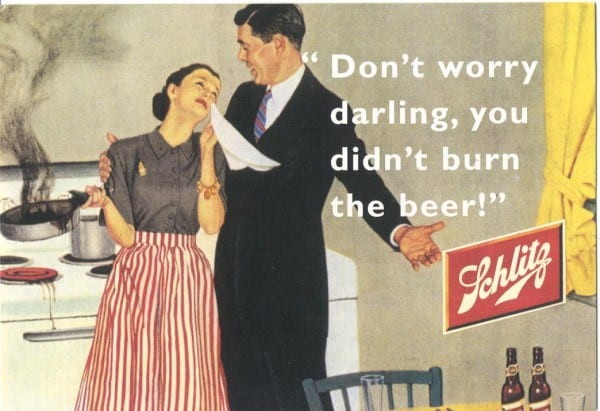
A woman incapable of cooking is comforted by her businessman husband- thank goodness she didn't burn the alcoholic beverages rather than the food right?
or
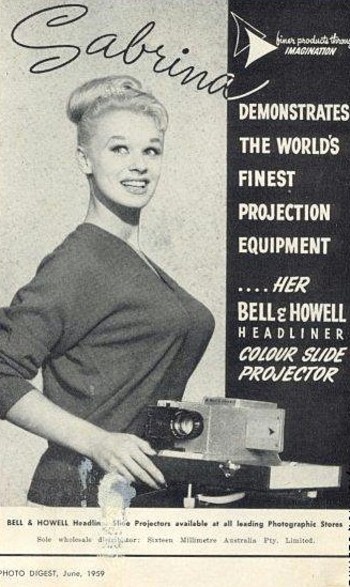
Oh so you're selling a colour slide projector? Im glad you included all the technical specifications
However, magazines made to contain "shocking" or "taboo" pictures looked like:
Highly artistic, colourful, portraying musicians- there might actually be an article inside!
Once again, very little is portrayed on this front cover that could reveal the contents of the magazine.
It would be "inappropriate" for me to post the front covers of modern playboys, as much as it would be inappropriate for those advertisements to be used today.
The woman in the 1950s occupies a very strange social status where she is adorned and undermined. Imagine the look of a 1950s tight-tied war-vet if he saw magazine covers like:

or

Today, some may be slightly taken aback by either of those modern covers but would most likely leave it to shock value or social taboo rejection, in the 50s, these covers might have burnt the magazine companies to the ground.
Both Professor and TA have mentioned there are a lack of comments on blog posts so perhaps a couple of questions might stimulate a few.
Have you seen any movies we watched (or were suggested to) that show a duality between the old woman and the new? Any characters in particular?
"Rebel without a cause" shows us a few signs of male-female role reversals (and how ridiculous the whole affair is to begin with), is Natalie Wood's character "Judie" a young rebel or a girl looking to be an old fashioned woman (and treated like it)?
Subscribe to:
Posts (Atom)