
It seems almost surreal for us to look at some ads and social behaviours of the 1950s, but it is equally true that some things we find totally acceptable today would have been unthinkable to the "father-knows-best" generation. For example, these ads from the past:


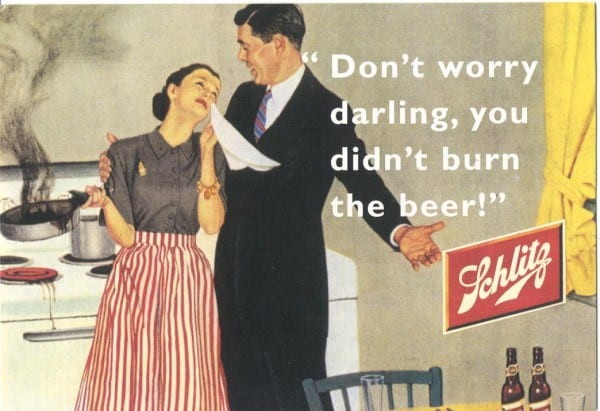
A woman incapable of cooking is comforted by her businessman husband- thank goodness she didn't burn the alcoholic beverages rather than the food right?
or
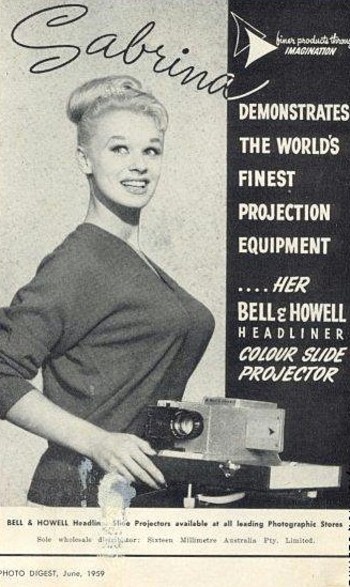
Oh so you're selling a colour slide projector? Im glad you included all the technical specifications
However, magazines made to contain "shocking" or "taboo" pictures looked like:
Highly artistic, colourful, portraying musicians- there might actually be an article inside!
Once again, very little is portrayed on this front cover that could reveal the contents of the magazine.
It would be "inappropriate" for me to post the front covers of modern playboys, as much as it would be inappropriate for those advertisements to be used today.
The woman in the 1950s occupies a very strange social status where she is adorned and undermined. Imagine the look of a 1950s tight-tied war-vet if he saw magazine covers like:

or

Today, some may be slightly taken aback by either of those modern covers but would most likely leave it to shock value or social taboo rejection, in the 50s, these covers might have burnt the magazine companies to the ground.
Both Professor and TA have mentioned there are a lack of comments on blog posts so perhaps a couple of questions might stimulate a few.
Have you seen any movies we watched (or were suggested to) that show a duality between the old woman and the new? Any characters in particular?
"Rebel without a cause" shows us a few signs of male-female role reversals (and how ridiculous the whole affair is to begin with), is Natalie Wood's character "Judie" a young rebel or a girl looking to be an old fashioned woman (and treated like it)?

I feel as though with modern day representations of women we are made to believe that there is this "new wave" of feminism although this isn't really the case. There is definitely an increased amount of female promiscuity in films today- there are female characters who are promiscuous and assertive in their sexualities however it's usually presented as something comical, and these women are almost always tamed by the end of the film and married into the patriarchal order. Although I think it's great that women have more ability to present their sexualities than in the past, I think there are some seriously problematic issues still at hand (Why does being "slutty" have to be portrayed as funny, when with male characters they are most often portrayed as "the man"? Why do they need to settle down at the end of the film?) I definitely think these femme fatale characters still exist such as Vienna in Johnny Guitar when I reflect on movies today like Easy A or Mean Girls (along these lines..) but I feel doubtful to call it that much progress. I think the movies want to make these women old fashioned by taming them in the film's conclusion.
ReplyDeleteI think Marilyn Monroe is a pretty progressive woman for this era. I've only watched Some Like It Hot, which isn't a great example of the point I'm trying to make... She really just looks nice and then settles down with one of the male leads. That aside, I think her presence as a celebrity was pretty racy for the 50s.
ReplyDeleteThink about that famous photo of her skirt being blown upwards. On one hand, one could say that she's just being subjected to some sort of 'male gaze', but i think to leave it at that would be insufficient. She rocks this photo and I think that it shows that women were beginning to take control of their bodies and their sexuality in a way that hadn't really happened before. If anyone labeled her 'skanky' or something, it wouldn't have mattered because she would have known that secretly everyone wanted her. She ultimately comes out on top of all the ogling men.
I mean, it's not quite pregnant, fully-nude Demi Moore, but it's getting close.
This is quite interesting, but I'm not sure what to make of it. I am particularly taken by the radical difference between the Playboy covers of the 1950's and those that would be used today. I wonder why it is that they are so tame, as I would have thought they would be at least as sexually charged as 50's advertisements.
ReplyDeleteYou're right to say what's socially acceptable now wasn't back then, and vice versa.. But while i was looking at the covers of Vanity Fair and Time magazines I kept thinking how highly inappropriate I find these pictures. My point being just because it's published doesn't mean it was considered acceptable by the whole society, I'm sure many think it's a bit much and won't buy the magazine. Then again, I guess it doesn't bother those people enough for them to do something about it.. Back then maybe they would burn the company down :[
ReplyDeleteIn response to "MM"s comment that femme fatales like Vienna still exist, one that i'll never forget is Uma Thurman in Kill Bill volumes. Somewhat like Vienna, she embodies masculine behaviour way more than feminine ones as a ruthless martial arts assassin ironically addressed as "the Bride" throughout the film.
In Imitations of Life, Lora faces a dilemma between choosing a career and being a good mother. The audience even criticizes Lora for choosing her career over performing her domestic duties. She doesn’t feel bad for neglecting her daughter until Suzie confronts her. Perhaps the reason why we don’t sympathize with Lora for choosing to have a career is because of her career choice, we might have felt differently about her decision had she chosen to become a doctor instead of an actress.
ReplyDeleteIn Rebel Without A Cause, I don’t see Judie as being a rebel that much. Judie does everything she can to please her father. When he slaps her, she gives up and leaves her house to meet Jim. But even by leaving her house, she is trying to get attention from her father and not actually rebelling against what her father wants her to be.
The Playboy cover you posted is very interesting. Maybe it was considered suggestive at the time to have the bunny looking under the girl’s skirt. This shows that what we consider to be suggestive changes with time. For example, the 1767 painting “The Swing” shows a woman on a swing letting her shoe go in the air while a man is looking under her skirt. When we look at this painting today, we do not see it as suggestive at all, however it was considered to be very suggestive at the time. It’s interesting to think that for us, in this decade, we consider the nude and pregnant Demi Moore to be suggestive. I wonder what will be considered as such fifty years from now. Perhaps a completely nude male or female model? Will body parts even be censored a century from now?
Here is the painting I was referring to: en.wikipedia.org/wiki/The_Swing_%28painting%29
I just watched Kill Bill last night and got thinking about Tarantino's use of female assassins throughout a large number of his films. In Kill Bill, Tarantino sets up both Vol. I and II to follow girl on girl fights, with both knives, guns and fists. In Death Proof as well, a girl gang sets out to torture and murder a male rapist. This scene from Death Proof, from the final moments of the film, demonstrates the director's portrayal of the 'empowered female':
ReplyDeletehttp://www.youtube.com/watch?v=tXowTxmhQ5w
(start at 1:00ish)
In response to Simon's second question, I definitely see a shift away from female domesticity in present-day films, but I agree more so with "MM", that feminism is often claimed when it is not deserved.
For example, in Tarantino's films, when women are given assassin roles or perform jobs that are gendered male (such as the radio hostess in Death Proof), they do so in a way that is highly sexualized for male viewing pleasure. When Uma and Lucy Liu are sword fighting in Kill Bill, both women have their long hair down and wear heavy makeup and sexy outfits. While this fight scene is a big step forward for female roles in Hollywood, it is hard to distinguish many of Tarantino's girl fights from sweaty lesbian pornography. Similarly, Death Proof represents a sort of fantasy world wherein 5 glistening babes in a muscle car chase a man through the desert in a plot to beat him up. Although the girls kill him in the end, if you switch out murder for an orgy, the plot is somewhat of a sexy daydream.
The women in Quentin Tarantino's films are given far more agency than would have been allowed in the 50s, and often take on rebellious roles like Jim Stark's, yet their rebellion is always sexualized and turned into a spectacle of fantasy.