DOs and DON'Ts

DO post comments, questions, observations, ideas, feelings opinions, etc. on lecture material, films, tv shows, conference discussions, and readings. DO respond to each other's posts in a thoughtful manner. DON'T be rude or antagonistic towards your classmates. DO post links to videos or other material that relates to the course. DO make connections to other films, shows, etc. DON'T post spoilers from films/episodes that we haven't screened yet, or from the independent viewing lists. DO use a conversational tone if desired. DO check the blog regularly and post as much as possible!

Friday, 12 October 2012

The Pointier, the Better!

I find this ad amazing, but then I also think this would just make me seriously self-conscious...


via: http://www.mintagevintage.com/fashion/1950s/how-date-vintage-clothing-1950s/

Thursday, 11 October 2012

The Coining of "McCarthyism"

Hey 2:30 Peel conference! Here's my artifact!

“You Mean I’m Supposed to Stand on That?” 1950
Graphite, ink, and opaque white over graphite underdrawing
Published in the Washington Post, March 29, 1950 


We only spoke a little about McCarthyism in Johnny Guitar last class, but it reminded me about the sycophancy article and the Hollywood Blacklist. While looking around online, I found the original cartoon that coined the term “McCarthyism”. The cartoon below was drawn by Herbert Lawrence Block (Herblock) and was published in the Washington Post March 29, 1950. The cartoon depicts Republican Senators Kenneth S. Wherry, Robert A. Taft, and Styles Bridges and Republican National Chairman Guy Gabrielson pushing the Republican elephant toward an election platform of a tar and smear campaign. Herblock’s cartoon was produced within six weeks of Joseph McCarthy (Republican US Senator -Wisconsin)’s announcement that he had a list of 205 known communists.

Johnny Guitar was released during the height of the Hollywood Blacklist era. (1952-56). As we discussed in class, the saloon is a sort of stage or performance space in the film. Johnny Guitar enters the town under the identity of a musician, Vienna is barged in upon by the mob while she is playing the piano on an elevated stage, Emma shoots The Dancing Kid... the way these “performance-oriented” characters are targeted by the townspeople reflects McCarthyism in Hollywood during the Blacklist era. How else can we read the spaces and characters in the film as interacting with McCarthyism?  


Eve Kendall in "North by Northwest" vs. Joan Crawford in "Johnny Guitar"

Did anyone else see a similarity in the evolution of these two characters?
I found it interesting to contrast the two in terms of their behaviour, but essentially who is made to appear to have the power and control throughout the films.
In "North by Northwest," Eve Kendall is soft-spoken, beautiful, flirty, and not afraid to show it. She uses her sexuality to gain control and essentially get ahead - using Carry Grant as if she is the stereotypical man. Though Vienna in "Johnny Guitar" is originally made out to be a hard-ass, with widened eyes and all the masculinity a female could have at the time, she eventually does soften and is shown being completely vulnerable (in her pink dress, might I add).
It just made me think of how if ever a woman was given power (or the audience, at some point in the film, was made to believe that they were), the power was clearly taken from them and given to a male character by the end - and they were made to seem reliant and vulnerable. This is clear with Vienna as we saw in the film, and could not be more clear by the way Hitchcock had Kendall hanging on to her male love interest's arm, hoping the very man she tried to control in the beginning would save her life.

Wednesday, 10 October 2012

Hitchcock: The Movie


Given that I selected two of his films for our film journal assignment, it is a great time for this movie to come out for us students in this class! This movie features the great Sir Anthony Hopkins as the great Alfred Hitchcock, as well as Helen Mirren. The movie is a biopic that offers an inside look into the director's life and struggles while making one of his ultimate classics, Psycho. While the actors of this film can really do no wrong, the movie itself looks quite intriguing, as Alfred Hitchcock was quite the intriguing man.

I thought I would share the trailer here. Enjoy! :)

Joan Crawford: Queen Bee

In keeping with the theme of today's lecture, I wanted to point out Joan Crawford's later works and how she defined herself in Hollywood as a "queen bee" who got what she wanted, on her own terms. Crawford's performance in "Johnny Guitar" makes her role so much more convincing and her widely emotive facial features allow her interior motives to be fully exposed.

Take a look at this trailer from her 1955 film, "Queen Bee." It's another look at the Mean Girls theme and Joan seems to play almost the identical character to Vienna.

Lastly, compare these to another 1955 Crawford movie, "Female on the Beach." It doesnt look like the most stimulating movie, but Joan appears to have been a staple for playing the love-to-hate-her Lolita.


Sterling Hayden's path to fame


A film legend, it only takes a light sightread on Sterling Hayden's bibliography to appreciate the eccentric greatness of this character. It can, and has been argued that Hayden is the greatest American actor of his generation, not simply on screen, but in his time off... His commonly acted "brutish outlaw with morals" was similar to his character- and he actually had a great reputation as a soldier. He held the pseudonym "John Hamilton" during his time as an elite commando and later a Captain in the OSS (receiving a Silver star for bravery one might add). He also sailed around the world multiple times and received his first command at 19. After two movies he took a break from Hollywood to fight in World War II as a gunrunner ("gunsailor" perhaps being a more accurate term) from Italy, through German lines and to Yugoslav partisans ( he also enjoyed parachuting into Croatia behind enemy lines, for which he was awarded a Bronze Arrow device and a personal commendation from Yugoslavia's Marshal Tito). He famously said "You don't need talent to star in a motion picture. All you need is some intelligence and the ability to work freely under the lens. Why do I always freeze? I went through the war. I jumped out of bombers. I played kick-the-can with E-boats when all we had was a lousy 40 foot dragger with six machine guns and a top speed of six knots. Yet whenever I get a close-up in a nice warm studio, I curl up and die".
In relation to his later problematic fame, Hayden admired the courage of the Communist fighters so much that he briefly joined the Communist party. He became sympathetic to Communist workers unions in the US and cooperated with the House of Un-American Activities Council, "telling names". He regretted this event deeply, although the names he reported to the committee already were very likely in their hands.
Hayden acted in movies such as Asphalt Jungle (a movie which also held Marilyn Monroe's first important role), Dr. Strangelove (directed by the one and only Stanley Kubrick), The Killing (also Kubrick and would later serve as the inspiration for Quentin Tarantino's Reservoir Dogs) and The Godfather. He repeatedly expressed his distaste for acting, talking of how he didn't do any movies for a year and was getting paid 70, 000 dollars for it.

I highly recommend watching a few of his movies as I believe his melodramatic role in Johnny Guitar does not do him justice. In my opinion, Johnny misses the touch of darkness which can be found in Sterling's other movies, and the very choppy dialogue reduces his usual talent.

Asphalt jungle clip:
http://www.youtube.com/watch?v=_2gDruB61Lk

Interview in 1983 (beginning):
http://www.youtube.com/watch?NR=1&v=kwsKDBca-h4&feature=endscreen


15 minutes

Andy Warhol said in 1968: "...in the future everybody will be world famous for fifteen minutes."

To follow my post below regarding social media, I'm wondering if this is what he was referring to...?

I am curious to hear other interpretations of this eerie "premonition".... thoughts...?
Is it seen as foreseeing or forewarning...?

MOVE: A follow-up to KONY 2012


For the students who are in the Thursday conference from 2:30-3:30, last class we talked about many difference between media culture of the 50s versus today, and the KONY 2012 YouTube/ social networking phenomenon was brought up. No matter which perspective you choose to view this advertising campaign, if you took the time to watch the last video, you should watch the follow up video - just released on October 7, 2012.

90, 913 people have already viewed this video...in only 3 days... a clear example of how things go "VIRAL" in today's times. 

I try to imagine what the past media & culture would have been like if these technology and social networking tools existed... just food for thought.

Femme Fatale..... and Lindsay Lohan

Two subject matters I personally never thought would be associated. Anyways, I figured before we left the topic completely, I just wanted to bring attention to 'The Canyons', an upcoming thriller film-noir that stars.... Lindsay Lohan, pretty much as her self apparently. It circles around the ideas of youth, sex, and glamour in 2012. It would be interesting to hear peoples thoughts on modern film-noir. To me, judging from this trailer, it seems to be some sort of adapted, perhaps somewhat distorted depiction of Lohan's life itself.


Good Night, and Good Luck


I watched George Clooney's 'Good Night, and Good Luck' over the weekend. It's set in the 50s, and tackles the subject of Edward R. Murrow's response to McCarthyism. I think this is an interesting subject considering the allegory for McCarthy's witch-hunts in 'Johnny Guitar.'

But what really struck me was Murrow's 1958 speech, all true text paraphrased from his actual words. The full text: Edward R. Murrow's 1958 Speech: RTNDA Convention

Here's an example of someone who was fully aware of the spectacle that was 1950s TV, citing its "decadence, escapism and insulation from the realities of the world." I was reminded of Professor Schantz's comments in the first few days of class, wondering whether viewers were aware, and just trying to survive the 50s.

I think the speech is incredibly relevant to both the 50s film industry and that of the present day--it seems so prescient about current relations to the media!

Any thoughts?


“She has the smile of an angel, fights like the devil”


Nicholas Ray’s femme fatale personas, Vienna and Emma, in Johnny Guitar (1954) dictate the course of action through feminine mastery and performance.  Both Vienna and Emma inhabit queen-like roles ruling over their own separate empires in the Western world.   The clash of the two queens frames the familiar collision of lawlessness, outlaws and alleged rule-abiding folk.  The passions and desires of the feuding females act as the driving force of narrative conflict.  Both Vienna and Emma adopt untraditional female roles within the Western genre, displaying characteristics more typically associated at that time with masculinity.     

"Never seen a woman who was more of a man. She thinks like one, acts like one, 
and sometimes makes me feel like I'm not." -Ray's Johnny Guitar


In a similar fashion, Elliot Silverstein’s film Cat Ballou (1965) features another powerful woman who inhabits a different kind of female role.  Silverstein’s Cat Ballou persona, played by Jane Fonda, draws on similar tropes of female behaviour. 

"She was the Queen of the outlaws, her Highness Cat Ballou" -Silverstein's Cat Ballou


By examining the aforementioned three female characters (Vienna, Emma and Cat Ballou) I hope to better understand the role of female desire and agency in these two Western genre narratives.  Are they the unwitting instigators of the senseless violence and masculine showboating? Or is their orchestration of such events a conscious manipulation?


Tuesday, 9 October 2012

Artifact: Concepts of Masculinity in Johnny Guitar


Consider this popular tune by country artist legend, Johnny Cash and pay close attention to the lyrics.
Cash talks about the railroad and how he "shot a man in Reno, just to watch him die."


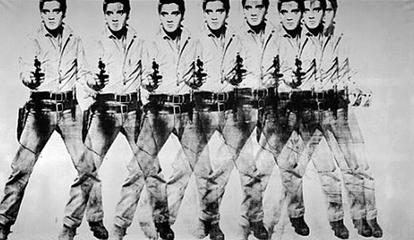
Consider the following famous painting by Andy Warhol of a cowboy Elvis holding a gun.


These masculine 1950s icons seem to have an association with cowboys, guns, and violence. I'd like to compare this concept of masculinity to the kinds of masculinity depicted in westerns such as Johnny Guitar.

How does one gain respect and status in the West? In Johnny Guitar it appears that whoever can draw their gun the fastest is the most well respected. Physical strength and a reputation for not being reckoned with also goes a long way. There’s a reason the west is wild, and it’s because some of the men revert to their animal instincts in order to gain respect.

I'd like to engage a discussion and close-reading of the opening scene in Johnny Guitar at Vienna's Saloon; how it is a critique of the manners and stereotypes associated with cowboy masculinity. How do the men present themselves to one another? How do they show dominance over one another? What are the traits of an alpha male?

These two instances stand out in particular:

1. Bart offers Johnny whisky, Johnny politely refuses, and a confrontation ensues.

2. Turkey, the "boy" shows off his gun slinging abilities to Vienna. Johnny, the "man" shoots the gun 
out of his hand.


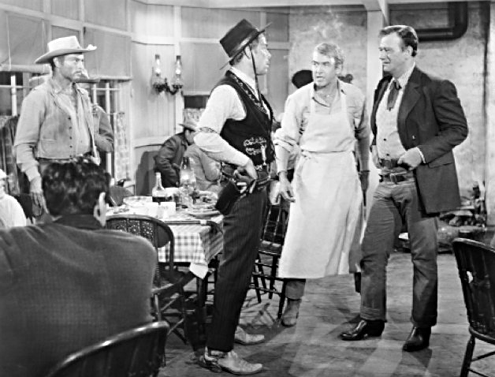
Take another famous Western like The Man Who Shot Liberty Valance. Tom (John Wayne) is respected because he's a quick draw. People don't mess with Tom, such as bad guy Liberty Valance. In the scene pictured below, Tom (far right) saves Ransom (centre in apron) from Liberty (black cowboy hat). As one can see, reputation and gunslinging abilities are important aspects in cowboy culture.


Questions to Consider:

1. How do confrontations between males in Johnny Guitar compare to degradation ceremonies in films such as The Apartment? 

2. At the end of The Man Who Shot Liberty Valance, Ransom, the well educated new guy in town, is revered by the town for liberating them. He becomes their new leader and shifts the town from a wild west to a civilized community. How does this relate to what Annie says (around 1h 5min) about the new people moving in from the East? How does this pose a threat to cowboy culture? Her quote is below:


“You heard her tell how they were gonna run the railroad through here. Bring in thousands of new people from the east. Farmers. Dirt Farmers. Squatters. They’ll push us out … or you’re going to find that you, and your women, and your kids squeezed between barbed wires and fence posts.”

Monday, 8 October 2012

Artifact: Is Johnny Guitar an Allegory?

The following video illustrates the '50s general outlook on women's roles in society.


Women are belittled and portrayed as incompetent in 1950s ads, while women in Johnny Guitar were strong leaders. For my artifact, I will contrast the following images that portray women as incompetent and weak with the masculine women in Johnny Guitar.


Vienna's unconventional masculinity highlights that Johnny Guitar is not a typical western film, but perhaps an allegory of McCarthyism that took place few years earlier.

The McCarthy era targeted individuals who imposed threats to the United States, and prosecuted them without having evidence, much like Vienna's case. This era was also anti-androgenous and anti-homosexual, in which homosexuals sought refuge in the bar culture.

Vienna demands authority in the way she speaks and dresses. The changes she plans for the city impose a threat to the city. She owns a bar and is constantly ambushed by mobs, who accuse her of crimes without using evidence.


So my question is: Can Johnny Guitar be an allegory of Joseph McCarthy's "witch hunt" against threatening individuals of power (like Vienna), and also against bisexuals in the 1950s? 

America The Beautiful


Hey guys - I've noticed that a really common theme on this blog and in discussions has been on perceptions of beauty and of women. These issues obviously transcend generations, and while may take one form in say the 1950's, will take a whole other 50 years down the road. It is an easy assesment to say that media and society as whole create these expectations of people (more often than not these expectations fall on women) but for anyone that was interested, I recently watched 2 documentaries that touched on the topics of beauty and weight that I thought were relevant to these discussions. It is interesting to see that themes and issues that plagued young women years ago are still violently in existence today.

America The Beautiful Documentary - Website

Trailer for America The Beautiful

And America the Beautful 2: The Thin Commandments

Artifact

Hey guys!
For my artifact presentation this week I decided to focus particularly on women's fashion and how it seemed to parallel the social changes the various members of this group were experiencing during the 1950s. The teenage rebellion against an older generation's idea of what is socially acceptable can be best embodied by the poodle skirt, which allowed for greater freedom of movement among other things, while the arguable taming of working women is most associated with the popular, curve-enhancing pencil skirt (and how women also manipulated this image). I'll be linking these two items with the female characters we've seen so far (especially with the women in Imitation of Life) and their behaviors/social positions.
Let me know what you guys think and I'll see you at conference Friday!


Picturing the U.S. from above


Check out this LIFE spread of pictures taken from a helicopter in 1952:


From the website:

“Sixty years ago the notion of a photographer going up in a helicopter to take pictures of landscapes, monuments, buildings and other notable sights from the air was novel enough to warrant a 12-page article in LIFE magazine.

The pictures from the assignment, on the other hand, can still startle and even astonish viewers today, six decades after Bourke-White made them. As expressions of one woman’s – and one magazine’s – endless pursuit of new ways to celebrate America’s breadth, energy and its vast, thrilling scale, the pictures here are unparalleled.”

Pictures from this kind of view are so common these days, it’s crazy to think of what the reception would have been like from people who had never seen America represented this way before.

Also, I wonder if we could think of this view as not just a bird’s-eye view, but “bomb’s-eye” as well – taking into account the paranoia of the Cold War. The scale of the pictures could certainly be seen to make America look “vast” and powerful, but I think that it also hints at a vulnerability – if a camera can capture so much area, with so many buildings and landmarks, how much damage could a bomb do from the same height?

Vienna as a Femme Fatale?

After watching Johnny Guitar, I felt as though Vienna was a strong-willed character and commanded power within the narrative despite her gender. She is a woman who owns her own saloon and calls the shots within what goes in her establishment with a "no nonsense" attitude. This is made very explicit at the beginning of the film where we see the male workers in the film comment how they have never worked for a female before and how she is very demanding for a woman. When MacIver and the locals show up at her saloon attempting to overthrow her, she stands strong against their will and does not back down regardless of their threats. Her ability to make them re-locate and surrender as she holds her gun demonstrates the power that she has as a female character, which is undoubtedly rare for the 1950s. Due to her romantic entanglements with both Dancin' Kid and Johnny Guitar, she leads them to put themselves in danger for the remainder of the film and therefore leads to my question of whether we can regard Vienna as a femme fatale character? What do you guys think?

PS I'd also like to add that her excessive use of red lipstick made me notice her uncanny resemblance to Ronald McDonald....

Sunday, 7 October 2012

I know that it's a show about the 60's, but what are people's thoughts on AMC's Mad Men?

McCarthyism and Paranoia in Johnny Guitar

When watching Johnny Guitar, I was amazed by what, in my opinion, were pretty blatant references to McCarthyism and the paranoia that existed throughout the 1950s. I am really interested in this topic and was especially shocked by the scene in which the locals led by McIvers and Emma try to force Turkey to "expose" Vienna for her involvement in The Dancing Kid's illegal activity. Literally covered in blood, almost on his death bed, Turkey is pulled up by two members of the locals while McIvers stands in front of him. Through intimidation tactics such as surrounding him and referencing that he's "got a rope around his neck" and better talk the locals try to force Turkey into a confession. Emma even states "Vienna got Jake to open the bank for you, didn't she?" as a way to elicit a specific confession. Vienna even encourages Turkey to say it. When he shakes his neck yes, the initial reaction by Old Tom is "He's a liar. You scared him into lying!" before the other locals silence him.

This scene directly references the intimidation tactics used throughout the McCarthy era. Furthermore, the unfathomable paranoia within the scene and the aspiration to hang Vienna and the rest of The Dancing Kid's gang on basically no proof further emphasizes the irrational responses to "enemies" within this decade.

Did anyone else see these acts as reflections on the paranoid reactions to enemies during the '50s? Thoughts?