DOs and DON'Ts

DO post comments, questions, observations, ideas, feelings opinions, etc. on lecture material, films, tv shows, conference discussions, and readings. DO respond to each other's posts in a thoughtful manner. DON'T be rude or antagonistic towards your classmates. DO post links to videos or other material that relates to the course. DO make connections to other films, shows, etc. DON'T post spoilers from films/episodes that we haven't screened yet, or from the independent viewing lists. DO use a conversational tone if desired. DO check the blog regularly and post as much as possible!

Saturday, 24 November 2012

50s fad: stick-on rhinestones

If you thought the 90s were bad for fads, check out this trend! From Life magazine, 1959.


Japanese titles for the movies we watched

Since I am an exchange student from Japan, I checked the Japanese titles for the films we watched and found it interesting to see how they entitled the same movie differently. So I will translate them to English!

"Imitation of life"→"Sorrows are over the sky"
"The Apartment"→"I will lend you the apartment key"
"No Way Out"→"The Avenger"
"Ace in the Hall"→"Ace in the Hell"
"Johnny Guitar"→"A Big Sandstorm"
"Rebel Without a Cause"→"Rebel Without a Cause"
"The Incredible Shrinking Man"→"The Shrinking Man"
"Glen or Glenda"→"Glen and Glenda"
"Invasion of Body Snatchers"→"Body Snatchers/The Town of Horror"
"Pillow Talk"→"Enjoy the Night"

They change titles for commercial reasons. You have different image for the film if it is entitled differently. And it maybe affects your interpretation of a film. You might see how they interpreted the movies by seeing those titles. And probably it is interesting to think to think how you would entitle each films after watching them. Although we didn't watch it in a class, I like the Japanese title of "The Spirit of St. Louis"(1957, Wilder), which is "Hey Wings! That is the lights of Paris".


Friday, 23 November 2012

How Hitchcock Got People To See Psycho


Following Monday's lecture, I found this interesting and relevant video about how Hitchcock advertised Psycho. By promoting it as an exclusive film that should be watched from beginning to end, Hitchcock made his film appear more important and persuaded the audience that the beginning is crucial to the understanding of the rest of the film. This changes people's perspective on the film as they will be focusing more on the beginning when watching it as they will be expecting it to explain the rest of the movie for them. This plays very well with the suspense in the film. The audience is therefore even more shocked when the main character Marion Crane, played by Janet Leigh, who is the center of the action in the beginning of the film is killed off not even halfway in the movie. The audience is already surprised by this as is, so having the director of the movie emphasize how important the beginning is makes her disappearance even more destabilizing to the viewer. Does anyone have any thoughts about this?


Black Friday: a term coined in the 1950s!

Today is Black Friday, but as I am not from North America, I wasn't exactly sure what it was until Casey explained it to me. Nevertheless, I was curiously as to why this day had such a dark, somber title. After having done a little bit of research, I found out that it was a term coined in the 1950s! Here's an extract from an article I found online:

"There are many stories about the origins of the term Black Friday. In the 1950s, some factory managers referred to the day after Thanksgiving as "Black Friday" because so many workers called in sick. The day, noted one industrial magazine, was "a disease second only to the bubonic plague" in its effects on employees. In the 1960s, police in Philadelphia complained about the congested streets, clogged with motorists and pedestrians out shopping, calling it “Black Friday.”  By the mid 1970s, newspapers in and around Philadelphia used it to refer to the start of holiday shopping. But its usage also has negative associations. In the1980s, some enterprising merchants turned it around. They pointed out tthat there was a "black ink" that showed up on balance sheets as a result of the day. “Black” refers to stores moving from the “red” to the “black,” back when accounting records were kept by hand, and red ink indicated a loss, and black a profit--a short hop to the idea that Black Friday was the day when retailers came out of the red and went into the black by beginning to turn a profit."

Source:  http://dyingforchocolate.blogspot.ca/2012/11/black-friday-cake.html

A Pin-Up's Legacy

Today in conferences we talked about the role of the pin-up in American society and pop culture in the 1950s. One student pointed out how they believed that Mariyln Monroe was the ultimate pin-up figure and set the tone for future Hollywood actresses.

After having read an essay by Saltzberg and Chrystler called "Beauty is the Beast," on the evolution of women's beauty in Western society and how they were always willing to suffer for it's sake, I am inclined to agree with the student's statement. Here is a direct quote from the article: "[In the 1950s] the ideal returned to the hourglass shape. Marilyn Monroe was considered the epitome of the voluptuous and fleshy yet naive and childlike ideal." 

In addition to pointing out how Mariyln Monroe's shapely body permitted her to attain a certain notoriety, I'd also like to redirect you toward this slide of photos of stars, from Rihanna to Nicole Kidman, all channeling Mariyl Monroe, thus proving how strong the cultural impact she had on people's viewing of beauty and sexuality was. 

Article: serendip.brynmawr.edu/sci_cult/courses/beauty/beast.doc
Slide: http://www.huffingtonpost.com/2011/10/12/23-celebrities-as-marilyn-monroe-photos_n_1005707.html#slide=402478 

Thursday, 22 November 2012

November 22nd Artifact: A Societal Shift from Representing Female Domesticity to Female Sexuality?


            How have women’s representation in the media changed between the 1950’s and now? In the 1950’s, women’s subordinate social and occupational status was quite visibly shown in TV commercials. Though, are current media depictions of women truly progressive? Are women really portrayed as empowered and independent of male dominance in present-day TV commercials? In particular, I would like to inspect how the representation of women has seemed to evolve from repressed and domesticated (in the 1950’s) to (in the present-day) a highly sexualized and commoditized figure. The clip below shows a 1950’s Ford commercial. In it, the female lead is portrayed as highly immobile in relation to her (apparent) husband, while a second car offers her a new sense of social freedom. She states that without the second car she is literally grounded to the home, using the term “prisoner” to describe her immobility and domestication. She states that while her partner is out doing business during the day, she could not see her friends; take part in PTA activities, or even shop. The division of labour here is quite evident; her desired activities are mere social arrangements and shopping, while the man is out working. Throughout most of the commercial, the woman is situated in the kitchen, viewing the vehicle through the blinds—thus reinforcing her supposed role as a housewife. Here, we can see how TV commercials in the 1950’s were instrumental in reinforcing female domestication.


          While the next clip portrays women with a far more liberated allure, this Chevrolet commercial also devalues the female subject as they are highly sexualized and quite literally controlled by men. While two male narrators are dictating what occurs in the commercial, they choose which woman drives based merely on their appearance. They say: “(she’s) hot, totally hot…a blonde, a redhead.” This shows that, even though women are driving, they are still a creation of male desire. The female role in the commercial is highly sexualized, as women are seen as objects that are beautiful; though also highly replaceable as the narrators cycle through three female drivers based on their hair colour. Thus, In relation to the 1950’s Ford advertisement, women here appear to be portrayed as much more liberated and independent, though at the same time they sexualized and commodified as the male narrators are actually creating their physical appearances based on their desires. As such, have women’s representation in commercials merely shifted from their domestication to sexualization? While the 1950’s Ford commercial concretizes the notion of the division of labour between men and women, the recent Chevrolet commercial puts women at the whim of male control and dominance. In this way, have media representations of women really progressed since the 1950’s? Can we conceptualize these commercials as representing an underlying societal shift in the US—from the repressive livelihood of female domesticity to their sexual objectification?


Wednesday, 21 November 2012

The Housewife as a Host

After class today, I was left thinking about proper etiquette for the host and the guest in the 1950s. So when I searched around, I found a bunch of videos portraying proper 1950's host etiquette, mainly for preparing meals and organizing parties. But then I found this video which connected a wide range of topics.  It presents the cultural norms of the time: the 1950's gender and family roles and the proper housewife etiquette one is encouraged to present as a host at home and in the public. Additionally, the typical housewife is also shown as a host for a television show, connecting ideas of the host and guest etiquette as well as etiquette for hosting television shows.  The housewife as a host of a television show is worlds apart from Serling or Hitchcock's tv hosting, not only in content but also in style. Also, I found it interesting how, even though the housewife is hosting the tv show, there is still a male tv host who is doing the "real" hosting of the show, who has the voice, the attitude and the jokes ready at hand.


I just thought that the range of connections between concepts was quite interesting. Thoughts?

The Anatomy Of A Turducken

Happy Thanksgiving to all Americans! I found this unusual yet "legendary" (as the article says) recipe for a Turducken. This seasonal "dish" is made of a chicken, stuffed inside a duck, which is then stuffed inside a turkey => Turducken! Mmmmm! Delicious! [not really, it actually sounds a bit disgusting] haha! Check it out: The Anatomy Of A Turducken.

Marilyn Monroe's Turkey Recipe

Happy Thanksgiving round two! Saw this in The Atlantic today (read the complete post here).

"Handwritten on a piece of insurance company stationery in 1956, the recipe is meticulously detailed, noting every step and every last ingredient. Monroe even took care to specifying the quality of the produce needed."

marilynturkey2.jpg

1950s-style PSA on JKL!

Hi everyone! I was watching Monday's episode of Jimmy Kimmel Live when I saw this. It is an imitation of 1950s PSAs. I thought it was funny how they made the video be of bad quality to make it similar to the 1950s videos. The narrator is also trying to mimic the narrators present in typical PSAs, such as the ones we've seen in the class and previously on the blog.  He also imitates the way they spoke in the 1950s, even though to me it sounds like he has a bit of a Canadian accent, especially when he says "pop" for soda and says "eh" multiple times in the video. I really like how at the end they say: "Brought to you by LEAD. It's in Ev'rything!" to imitate the way they mention sponsors in 1950s PSAs and to make a joke about the lack of scientific advancement and the lack of knowledge about the dangers of lead at the time. Does anyone have any thoughts about this? 


Tuesday, 20 November 2012

Tricking Husbands into the Kitchen


While I was looking for an artifact I came across this video called ‘A Word to the Wives’ (1955) that stages a pair of women ‘tricking’ one of their husbands into spending 2 days alone at home struggling with the inadequacies of their kitchen (in an attempt to have him realize its inadequacies and buy his wife a new one). When the husband tries to prepare food for his son and get things done in the kitchen he becomes instantly frustrated and irritable and ultimately fails in taking on the domestic role. 


This joke also ran through the famous I Love Lucy episode “Job Switching” where Lucy and Ethel work in the chocolate factory and Ricky and Fred attempt to cook dinner and do housework (sorry for the poor quality!).


I think it’s interesting to look at how power functions in both of these videos, as well as the place of trickery. Although both videos do assert the necessity for women to keep to the kitchen and men to keep to the workplace, by the end of ‘A Word to the Wives’ the wife is ultimately successful in getting her new kitchen and proving her domestic importance to her husband. The ‘trick’ in the first video is successful, while Lucy’s countless tricks throughout her series rarely work on Ricky. I think it’s also interesting how the kitchen is represented as a kind of foreign space for men – in case it was unclear that women are to remain in the kitchen, the videos represent just how out of place men would be in domestic roles.

Pillow Talk Trailer

Since the next movie we'll be watching in screening will be Pillow Talk I thought it would be interesting to look at the trailer that was released to promote the film.
http://www.youtube.com/watch?v=qtjozLb1a5Q

How does this trailer compare to trailers that are released now a days?
Is there a huge difference?
It also might be cool to look at some of the other trailers released for the other films we've watched in class or from the recommended list.
It provides some understanding of who the film was intended for and how the film was marketed in terms of promoting genre norms.

Monday, 19 November 2012

November 23rd Artifact : The American Dream Disillusion in West Side Story Musical..


The West Side Story musical brings to the table the actual difficulties that immigrants would face arriving in the United-State in the 1950's. Racism, discrimination, unemployement and marginalization were part of their everyday life, but yet they had a strong believe that everything could change for them in this ''free'' and ''modern' place. 
Another interesting thing to think about in this video is the sum up of the american life; women singing about the washing machine, buying on credit, cars etc. Men on the other hand bring up the sometime cruel reality of the american racism. Here are the lyrics if you want a have a look on how the opposition is constant and well examplified : 

I like to be in America
Okay by me in AmericaEverything free in America
For a small fee in America
Buying on credit is so nice
One look at us and they charge twice
I´ll have my own washing machine
What will you have though to keep clean?
Skyscrapers bloom in America
Cadillacs zoom in America
Industry boom in America
Twelve in a room in America
Lots of new housing with more space
Lots of doors slaming in our face
I´ll get a terrace apartment
Better get rid of your accent
Life can be bright in America
If you can fight in America
Life is all right in America
If you´re all white in America
Here you are free and you have pride
Long as you stay on your own side
Free to be anything you choose
Free to wait tables and shine shoes
Everywhere grime in AmericaOrganized crime in AmericaTerrible time in America
You forget I´m in America
I think I´ll go back to San Juan
I know what boat you can get on
Everyone there will give big cheers
Everyone there will have moved here
I think I´ll go back to San Juan
I know what boat you can get on
Everyone there will give big cheers
Everyone there will have moved here
I know what boat you can get on
Everyone there will give big cheers
Everyone there will have moved here
Everyone there will give big cheersEveryone there will have moved hereEveryone there will have moved here


We may wonder how present was racism in the society of the 50's? Or how was the american dream idealized and represented in the immigrants minds? Was there a real chance of social ascention and integration ? What about immigrants representations in movies and on TV ?


Bye Bye Twinkies

With Hostess going bankrupt, Twinkies will becoming nothing but a memory. The 50's were coined "The Twinkies Era" as I recently found out while reading the NYTimes. (http://www.nytimes.com/2012/11/19/opinion/krugman-the-twinkie-manifesto.html.)

It's true that people are going to miss Twinkies, how could you not. But I think it would be a sad day for those who grew up in the 1950s. People from this time period often see the improvement of products they grew up with, but it's not as common for them to see something like this completely go away. Think about products from our childhood like Barbies and Lego going bankrupt! Just some food for thought (pun intended). RIP Twinkies.


Embodying Cool: The Contradictory Nature of James Dean (November 22 Artifact)


James Dean Driving PSA

Few film stars from the 1950's are well-known - let alone immediately recognizable - by our generation today. Those that are relatively notorious - Cary Grant, Marilyn Monroe, Marlon Brando - made many films and were highly acclaimed by the times of their deaths. In contrast, James Dean only made three films in his short career, yet is perhaps the most familiar star of that era. For those of you unfamiliar with him (or perhaps you have seen his iconic image in a leather jacket and jeans, but know little of the man himself), Dean was an American actor whose films - East of Eden, Giant, and his most famous, Rebel Without a Cause - 
became an icon for disaffected youth and teenagers across America for his depiction of non-conformity, disaffection and rebellion. Dean (and the characters he played) embodied the idea of 'cool' - he was a good-looking and smooth-speaking kid who had little respect for authority, only played by his own rules and could seemingly have any woman he desired. His death in a car crash cemented his legacy, as he died young, doing what he loved, and through a dangerous act.
Yet Dean's seemingly straightforward persona is actually rife with contradictions: seemingly uncaring, yet remarkably self-conscious; despite playing bitter young men, all of his roles had a tenderness to them as well; while he was certainly popular with women, he ostensibly had multiple relationships with men at the same time. Dean would often espouse one view (perhaps at his studio's behest), while acting out another. Below is a Public Service Announcement he did on racing on highways (note that he died in a car crash on a highway himself):


Classic Dean:


 Alternative Sides:


Discussion Questions

Why exactly did James Dean come to embody dissent and coolness? Did he merely come at a time when youth were particularly looking for an idol? Would he be as popular for our generation as he was then?

Did Dean's gentleness help his allure? Was/is a multi-layered and conflicted star more enduring than the stereotypically 'manly man' embodied by John Wayne or Marlon Brando? Does seeing the irony of this PSA in the context of his death make him less or more appealing as an icon? 

Did the 'easiness' of liking Dean's rebellion contribute to his popularity? In other words, was the fact that one could rebel against 'the man' through Dean - without dropping out of school, leaving home or getting into fights - make him an idol of a form of rebellion that most teenagers weren't willing to act on?

The Emergence of 3D – Artifact, Friday Conf


Although there had been experimentations and developments of 3D technologies in the silent film era, feature-length 3D films officially appeared and gained public attention in 1952 with the release of Bwana Devil. The film industry had been steadily losing its customers to television and desperately needed something new and different to regain their audiences. Despite the expensive hardware that 3D demanded and the time-consuming processes that were involved, the motion picture industry released several 3D films between 1952 and 1953 that proved successful and drew audiences away from their TV sets and back into theatres. The first 3D films were generally B-movies featuring science-fiction monsters, gore, action, adventure, foreign settings, and as one would expect, Vincent Price. 


However, this success was short-lived - there was a wide-range of difficulties that accompanied projecting 3D films (such as synchronization issues, the requirement of multiple projectionists, audience seating being limited to center aisles, etc.) and it was rare that a film made it through an entire screening without something going wrong. Viewers often complained of headaches and eyestrain after sitting through 3D movies and as a result, the regular versions of films often had more viewers.

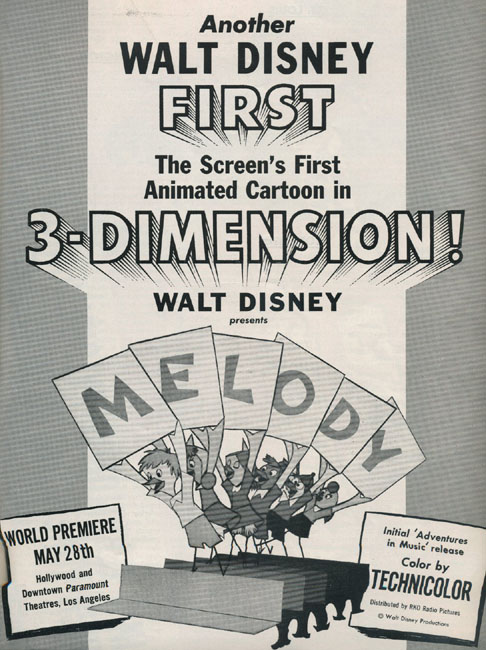
Despite 3D films’ general decline in popularity by the end of 1953, a second wave of 3D films were released in the following few years and even began to feature stars like Rita Hayworth, Dean Martin and Jerry Lewis. Popular directors like Alfred Hitchcock and Howard Hawks tried out 3D technology in their films as well. 3D cartoons gained some popularity (Caspar the Friendly Ghost and Popeye for example) and slapstick comedy like The Three Stooges’ also became reinvigorated with the potentials of 3D (imagine pies flying off the screen). 

3D technology clearly functioned in the 1950s as a form of spectacle. It revitalized the cinema-going experience and challenged the dominance of television. Arguably the spectacular element of the ‘cinema of attractions’ could be thought of as re-emerging with 3D in the 50s. The trailer for House of Wax (1953) really plays of this idea of spectacle and aesthetic pleasure; note how plot and characters are relatively ignored while the awesomeness of 3D technology is brought up again and again. 


So just to think about:
-what potential effects does the emergence of new technologies have on narrative? Do narrative and character development lose their importance when special effects (like 3D) are involved?
-while television represented an at-home comfort and convenience for 1950s consumers, 3D film represented a dramatically different type of entertainment experience. What meanings can be drawn from the contrasting qualities of these forms? Did television still ‘win’?
-has 3D’s popularity come in waves or is it now a norm? Is 3D still the thrilling experience it used to be advertised as? (take a look at how the 1950s posters advertised it compared to today’s)
-how is the theatre space represented in the advertisement for House of Wax? How can we think about 3D's 'entry' into our personal space?
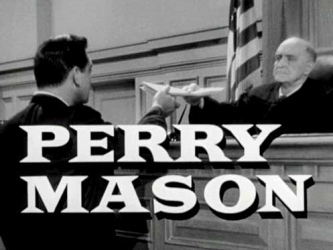
While watching the shows for this week, I couldn't help but compare them to modern day crime shows. Hitchcock Presents, Perry Mason, and especially Dragnet reminded me of shows such as CSI, Without a Trace, and even Suits. The difference is that crime shows today have become incredibly more melodramatic and exaggerated. They make it seem like every criminologist is a beautiful brainy woman with an impeccable wardrobe, and every lawyer has a glamourous life working in a prominent company in New York. In class we talked about how the discourse of the Dragnet episode appealed more to our emotions and moral values than to the actual crimes themselves (conning people is a pretty common crime that doesn't involve shocking fatalities or hardcore corruption). In these modern day crime shows, not only have the job representations become greatly dramatized, the crimes themselves are much more shocking and intense. However, in both the shows of the 50s and crime shows today, our moral and emotional attachment stays the same. The only thing that has changed is the way lawyers and detectives are now portrayed-- the representation of them has gone from pretty typical, seemingly real roles, to glamourous, high-profile ideals of the jobs.


While discussing the "Lamb to the Slaughter" episode in class today, I realized I had heard this story before from a book of adult short stories by Roald Dahl. While it seemed classically Hitchcock it is interesting to note that the story is in fact adapted from print!

http://en.wikipedia.org/wiki/Lamb_to_the_Slaughter


Sunday, 18 November 2012

Artifact - Fast Food and the 1950's - Conf Nov 23


The way American families experienced meal time first began to change with the introduction of ‘take-home meals’ or ‘TV Dinners’. This deviation from the norm (referring to the nightly family meals occurring like clockwork, prepared by the diligent housewife) helped pave the way for fast food and meals on the go. While many restaurants prior to the 1950’s did have take-out windows, it wasn’t until the integration of the speaker system that really increased the ease and efficiency of fast-food and made it much more appealing to the American public. Although McDonald’s was not the first fast food restaurant in America, it has become the largest, leading it to become the chain most associated with all things fast food. McDonald’s was the first to make use of the assembly-line production system within the realm of food, producing meals with higher efficiency and at higher quantities. This helped to standardize the food industry and popularize greasy American food such as hamburgers, French fries, and milkshakes.


As seen above, these images of both McDonald's and Burger King, two of the premiere Fast Food joints of 1950's America, show this new industry's focus on affordability (15c/19c burgers) and efficiency (self-serve windows). Here is also where we see the beginning of the integration of the auto and the dining experience.


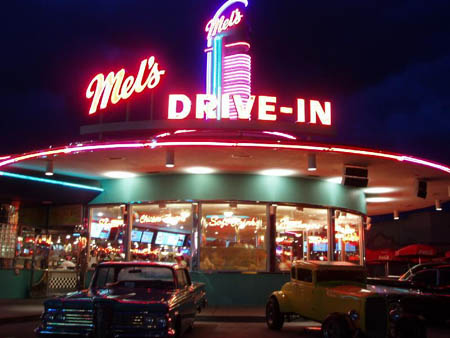
From there we see the progression towards curbside service, where patrons were able to remain in their cars and enjoy their meals with increasingly less effort. This drastically altered conceptions of meal time and of 'dining out', and it can be argued that drive-ins and curbside service completed the integration of meal time and food, and was even representative of the progressing autonomy of youth culture of the 1950's. Drive-Ins and diners were the new 'it places' for social gatherings and attracted youth in great numbers.


With the drive-ins separating meal time from the kitchen and helping to further emancipate youth and families alike through the conveniences of car culture, the drive-through only acted to magnify all of the perks of fast food - it was now quicker and more convenient than ever before, allowing the spheres of food and travel to now become intertwined. The first Jack in the Box opened in 1951 (seen above) in San Diego. The drive-through concept was so unfamiliar to people at the time that the Jack in the Box "clown" where the speaker was housed, held a sign saying "Pull forward, Jack will speak to you." For my artifact (illustrated above in the images of 1950's drive-throughs) I wanted to discuss how the drive-through signifies the culmination and integration of the most prominent spheres of 1950's life - cars, technology, efficiency, and a regeneration of traditional life.


Some things to think about:
- How the emergence of fast food chains reflects other emerging trends of popular culture of the 1950’s (car culture, new values placed on speed and convenience, the downfall of quality and the increased focus on quantity and consumption)
- How fast food not only revolutionized meal time in itself, but also had effects on farming and food distribution businesses
- Do you think that the emergence of these fast food chains helped to promote other trends of the 1950's, or was the creation of fast food chains just to help fulfill and meet the changing needs of society?
- How did the appeal of fast food help release women from the kitchen?

Kurt Vonnegut's "Report on the Barnhouse Effect" & Collier's Magazine: Artifact Presentation Nov. 23rd

Kurt Vonnegut's "Report on the Barnhouse Effect" & Collier's Magazine issue


A young Kurt.

I have decided to examine the first ever short story published by Kurt Vonnegut, "Report on the Barnhouse Effect," which made its debut appearance in Collier's magazine on Feb. 11, 1950, and later  appeared in Vonnegut's 1968 collection of short stories,  Welcome to the Monkey House. For what I'm assuming will be a very small minority of you who do not know, Kurt Vonnegut was an important Leftist Humanist author throughout the 20th century. He had served in the U.S. army during the Second World War, and was in fact a prisoner of war captured at the Battle of the Bulge in 1944. As a POW he subsequently survived the infamous fire bombing of Dresden of 1945 locked in a meat cellar. This event in terms of immediate casualties production was more devastating than Hiroshima or Nagasaki. For anyone familiar with Vonnegut, the influence of Dresden in particular, and his experience in the war in general on his work is more than evident. One of his most beloved and well-known works takes its title from the name his German captors dubbed their group of American POW's, The Slaughter House Five. Accordingly many of his works revolve around motifs of the increased militarization of American society, war itself, as well as sci-fi themes which frequently take the shape of time traveling, or the imagining of dystopian societies on far away planets. His work is known for its powerful social commentary, always portrayed with Vonnegut's quintessential succinct black satirical humor. I apologize if most of this is common knowledge, however I feel it important to at least mention of his amazing biography. I urge you to read up on him, or his works, if you're so inclined!
An older Kurt.


Feb. 11 1950 issue featuring Vonnegut's story.

Feb. 2012 Collier's Revival Issue.
Collier’s magazine which published this first remarkable short story was started in 1888 by Peter Fenelon Collier.  Under the name "Collier’s Weekly", the publication became known as a “proponent for social reform”. Collier's is considered an early instance of investigative journalism, or what Teddy Roosevelt in his time coined as “muckracking journalism”. According to Wikipedia, “muckraking journalism” was a term that, “Before World War I.... was used to refer in a general sense to a writer who investigates and publishes truthful reports to perform an auditing or watchdog function. In contemporary use, the term describes either a journalist who writes in the adversarial or alternative tradition or a non-journalist whose purpose in publication is to advocate reform and change”.  Naturally, this sort of publication is the perfect medium for Vonnegut's works. I think it is particularly interesting to note that Collier’s stopped circulation Jan. 4th 1957, for reasons I cannot seem to discern from online sources (does anyone else smell an Eisenhower-ian conspiracy?). Nevertheless, the magazine has recently been revived in February of this year, with its resurrection issue focusing on Okinawa 66 years after the War in the pacific theatre.

The issue in which Vonnegut's story first appeared is notable for featuring a piece about the 14th  Dalai Llama, who throughout the 1950s would undergo an ordeal due to incursions by newly Red China.  The issue in question also came out just 3 days before the signing of the Sino-Soviet Friendship Treaty on Feb. 14th 1950 between two of the most prominent cold warriors, The Man with the Iron Fist Josef Stalin and Chairman Mao. That treaty fundamentally changed the nature of the Cold War, and was in many senses a seen as a nightmare situation for the Western camp of the Cold War, particularly by American reactionaries, as overnight the world Communist population doubled. To view a pdf of the original issue in its entirety, which in my opinion is super interesting to look through, click here.

I won't ask everyone to read the entirety of "Report on the Barnhouse Effect" (Linked here), but I do endorse the idea as it is a quick enjoyable read for those of you who wish to indulge in some fiction. If you don't want to read it all, just go over the first page or two, then see if you can stop! Either way, the introductory pages sufficiently express many of the themes that characterize Vonnegut's work, and are those which I wish to consider as they are relevant to the course and thus the decade.

"Report on the Barnhouse Effect" deals allegorically through the generic mode of sci-fi with anxieties about the atomic bomb, the increasing weaponization and thus dehumanization of society, the strength of ideology and dangers that ideas can reify. In the story, a man named Professor Barnhouse, then serving in the armed forces, makes an amazing discovery while yielding to some of his barrack mates demands for a game of craps. He realizes after winning several games with incredible odds (1 in ten million) that something is awry, and eventually comes to the realization that he, an ordinary human has been endowed with powers which effectively nullify the destructive force of the atomic bomb. The story ensues with the attempt of the Government and security forces to weaponize his powers and ends with a twist reminiscent of the television series The Twilight Zone.

Questions to Consider:

What particular events/features of the 1950s American society does this story reference?
Does this story have a moral? If so, what do you think it is?
Has this story aged well, is it still pertinent today?
How do you think people reacted at the time to this tale?
How realistic do you think this story is? If the situation which it describes unfolded, what do you think the world's reaction might be?
Would this story have been more potent had it been told in another medium, particularly television or film? Why or why not?


Media Phenomena - Perry Mason

I was browsing the interwebs for some info about Perry Mason and was surprised to find that it has been published in just about every media format one could imagine.

Novels,


Comic books,                                                           Radio plays


 Comic strips,                                   and TV shows                                                                           
perma-001.jpg                                                                              


I wonder then if the 1950's marked the beginning of media phenomena. Was there ever a time before this era that a series was so widely reproduced across so many different mediums?

Lastly (as a side note) there are talks of a Perry Mason movie starring this guy as Perry:


I'd watch it...


Artifact: Representations of the Cosmopolitan Man in the 1950s and its use in Alfred Hitchcock’s “Rope”


For this Friday (11:30 conference), I would like to dive into significant style aspects of the intellectual cosmopolitan male of the fifties and unpack some issues dealing with consumer culture and identity in reference to Alfred Hitchcock’s film “Rope”. While most film scholarship deals with Hitchcock in reference to female roles, I would like to look into a short film that is centered on men. There is a profound crisis of the male contemporary man in the light of capitalism to build one’s own image to have him stand out and gain cultural and intellectual superiority. I will be discussing a few advertising images to further emphasize marketing strategies founded to have men identify with this need for superiority. 


When looking at Alfred Hitchcock’s film I would first like to discuss how this prototypical male image is being used through costume according to male leading roles in the premise of the film. This includes the suits and accessories, as well as the colors chosen for these costumes. Secondly, I would argue that like the “Lamb to the Slaughter” episode of Alfred Hitchcock Presents, there is a successful use of normative examples of gender and settings the fifties viewer would be accustomed to and that these visual codes are used against us to build suspense and form interesting plot twists.  I deem this to be very important to the film as these men do not appear to fit the bill of the average sociopath one would associate with in the McCarthy era, they “appear” to be perfectly normal upper class men.

I would encourage you guys to watch the opening ten minutes of the film as it really sets the story in place. I will be screening a small clip that is in the middle of the film and many aspects of the discussion that goes on in that scene relates directly to the beginning of the film. 

These are the images i will be discussing:


Phillip Morgan(Farley Granger), Rupert Cadell (James Stewart) and Brandon Shaw (John Dall)

"Cosmopolitan - the man who wears the Stetson with the Mode Edge"


"Success stands out" Johnston & Murphy
As a side note, what is also interesting to point out about the film is that it was inspired by a real event which is the murder of a 14 year old boy named Robert Franks by two wealthy University of Chicago undergraduates by the name of Nathan Leopold and Richard Loeb in 1924. Like the two male protagonists in Rope, they were motivated to murder the boy by the desire to commit a perfect crime. This however proved to be unsuccessful as they were eventually tried and convicted. Here is more information on that case: Leopald and Loeb

                  What I find most interesting and will aim to discuss is what your observations will be as per what we see in the clip on Friday but besides that, do you think that this urgency and this claim to superiority is as strong as it was in the 1950s? While we are much more at ease with an even larger capitalist society and commodity culture, are we successfully in tune with it?  Or is identity (male and female) today an even larger issue?