DOs and DON'Ts

DO post comments, questions, observations, ideas, feelings opinions, etc. on lecture material, films, tv shows, conference discussions, and readings. DO respond to each other's posts in a thoughtful manner. DON'T be rude or antagonistic towards your classmates. DO post links to videos or other material that relates to the course. DO make connections to other films, shows, etc. DON'T post spoilers from films/episodes that we haven't screened yet, or from the independent viewing lists. DO use a conversational tone if desired. DO check the blog regularly and post as much as possible!

Monday, 12 November 2012

Artifact: Let’s Make a Sandwich and other 1950s recipes


I love cooking and thought it would be interesting to examine how cooking and recipes have changed since the 1950s. For my artifact, I plan to discuss cooking practices of the 1950s and the common recipes that were used.

To begin, I will discuss the video entitled “Let’s Make a Sandwich” from 1950 in which a mother and daughter make a tuna rarebit sandwich for the boys. Narrated by a man, the informational video lacks important details such as quantities of each ingredient; thus, it is impossible to actually make the sandwich. For the modern viewer, the tuna rarebit sandwich, which involves a combination of tuna, rye bread, a cup of milk, and “cheese of an easy melting type”, sounds extremely questionable. Moreover, the accompanying side dishes such as potato chips as “useful accessory foods,” heavily contrasts with our modern emphasis on healthy food. Several moments of the informational video seem extremely humorous to the modern viewer such as the end of the video in which the narrator describes the tuna rarebit as “festive fare”. This video clearly shows how our taste buds, recipes, and recipe videos have changed since the 1950s. Also, the containment of women to the kitchen reinforces the stereotypical spaces of men and women in the house. This video is especially poignant in its actual representation of the now heavily disregarded and contested statement regarding women making men sandwiches.


I will also discuss different recipes such as Baked Alaska, questionable gelatin creations, and other recipes with accompanying photographs to illustrate the difference in cooking styles in the 1950s and today. While today recipes emphasize calories and nutritional factors, in the 1950s, recipes were celebrated for their ease and speed as well as their presentation and aesthetic quality.


To end, I wonder: why do our tastes change over the decades? Has our increased knowledge about nutrition today changed the way we cook and the recipes we use? At the same time, how did people in the 1950s stay so slim?


The Original 1950s Teenage Rebellion: The Teddy Boys


During the 1950s, the US and Britain experienced the uprise of the Teen Age cross-culturally.
So far we have often spoken of the 1950s as a time of conservatism and confinement, but it is also historic in that it was the birth of the teenager, which is one with the new ability to defy the "control culture" of adult society with more economical independence in the post-war society. The first moral panic in British society in response to a youth subculture were the Teddy Boys in 1954. A year later in America was the birth of rock n' roll, which caused its own moral panic in response to Elvis's dance moves and Jerry Lee Lewis's provocative ways.
In conference on Friday, I want to discuss the teenage phenomenon of the Teddy Boys in relation to the American teenage rebellion. A major indicator of the rebellion was their clothing. Although different, British and American youths began to make a distinct separation from their parents' and grandparents' attitudes, which was made apparent by their unique outward manifestations of their selves through the use of fashion.

The Teddy Boys: http://www.edwardianteddyboy.com/page2.htm (more images on site) 


The Greasers: 


Where all of these men just rebells without a cause? Or did society marginalize these youths who began to break away from the norms of their social superiors? Did they have a cause? Why did this first youth breakaway happen in the fifties?  
Which portrayal of youth was more realistic? Ozzie and Harriet's sons or the students from "Rebel Without a Cause"? 

See you Friday! 

Artifact Presentation (Thursday 2:30): Winston Cigarettes... Meet The Flinstones

My artifact for this week is not really related to other films or concepts discussed in class, but I just couldn't help my self after seeing these commercials.

This is how you all know and love The Flinstones:

Now, watch this and try to tell me that you can still see them in the same way:

 My main thought behind the artifact is to analyze the commercial and relate it to the broader 1950s culture, looking at how certain ideas of the era were disseminated through television.

Some questions to ponder:
- In terms of gender, who do you think the ad is targeted at, as you see both men and women smoke a Winston cigarette? What leads you to think that?
- This ad uses a children's themed television show but advertises an adult product. Who is the commercial targeted for? Young children of the 50's in order to groom them into early smokers, or are adults targeted in directly, for instance, while watching TV with their kids? If so, why advertise to adults in this manner?

I then researched a bit more to see if these use of cartoons and child-friendly techniques for advertising smoking and other adult products were common place. And I found this:
The cheerful, catchy tune, the rhythm that basically cancels out any recognition of what the voice is saying, and the child-friendly animated images, all made me think of ideas of communism in the 1950s - subconsciously infiltrating the viewers mind to make them think about cigarettes and associate them with the pleasant thoughts and ideas in the advertisement, without viewers realizing.

A few more questions to ponder:
- What are you thoughts on this advertisement? Can it be bundled together with the Flinstones ad with it's use of child-friendly techniques?
- How can we connect and compare these advertisements to contemporary cigarette advertisements?

Thanks guys!

Artifact Presentation: Mannequins and Nuclear Testing

Hello All!
So after being seriously creeped out by mannequins in our screenings of "The Twilight Zone" (and, honestly, mannequins in general), I decided to do a little more research into the use of mannequins in the 1950s. I came across a series of very interesting and slightly unnerving photos of mannequins being used in nuclear testing from LIFE Magazine.


I found it really interesting and quite strange that they used mannequins at all. Being made of plastic, wax, and synthetic materials, the results of the nuclear tests wouldn't really give an accurate representation of the effect of an atomic attack on human beings. The only reason I can see for using mannequins would be to reinforce the reality of humans being the ultimate target of nuclear warfare. Do you think they used mannequins in this manner merely to promote the hype and a "culture of fear" of sorts surrounding nuclear testing?
 Do you think there is any significance to the use of only caucasian mannequins? And the fact that no children mannequins were used in this series of photographs - does this indicate that some lines regarding propaganda such as this could not be crossed? Another thing to perhaps think upon is whether the use of mannequins had a positive or negative effect on the popular opinion of such warfare.
 

I've attached a few photos, but if you guys are interested in the rest of the series, just follow the link! I really suggest you do - very eerie but also very cool to think about!

LIFE Magazine - A-Bomb Mannequins

Thanks!


Thanks, y'all :)

I just wanted to say thank you for the encouragement and support before, during, and after my lecture today. It was so fun to get to talk to everyone at once, and your engagement really gives me a lot of confidence that I can handle this whole lecturing business.

So....thanks! You guys are the best.

Artifact: 1950's Video Games


In spirit of the 1950's sci-fi genre that we've been focusing on lately like Invasion of the Body Snatchers and Twilight Zone, I decided to look into another media artifact that incorporates sci-fi elements as well: video games. 
OXO
Tennis For Two
The 1950's saw the birth of OXO (Tic-Tac-Toe) and Tennis for Two in 1958. Prior to these electronic games, most activities were multi-person outdoor or board games that required the co-operation of several people to find the outcome of the winning person or team. With the advanced technology, however, engineers were able to muster up seemingly simple to us, yet very advanced for their time, computer games. These games required human and machine interaction.


OXO was said to be created for educational purposes. It was a one player game against a computer. Tennis for Two was a two player game, where players would play simulated tennis against each other with joy-stick controllers that plugged into the screen where the action played out in front of them. Tennis for Two became revolutionary in that it led to video game classics like Pong, Pac-Man, Mario, and all other modern video games and gaming systems we have today. 

As seen in class through the sci-fi genre, we know that special effects for TV and Film were on the rise, but they had not yet been applied to video games. These sci-fi effects were used to create "bizarre experiences" (as heard in the Twilight Zone Pilot) in TV and film. You could say that the technology of the 1950s video games also created these "bizarre experiences" through allowing human to interact with machine.

Halo 4, 2012
 OXO and Tennis for Two seemed to be very fun and harmless games. Today, however, our video games are denoted as violent and inappropriate. When do you think that this switch came into play? Why did video games go from being merely co-operative and fun activities to dangerous games focused on shooting and killing? What did the games of the 1950's say about the values of that time period?

Cool behind the scenes picture

This is coming a couple weeks late but I came across this picture from the set of "The Incredible Shrinking Man" and thought I'd share.


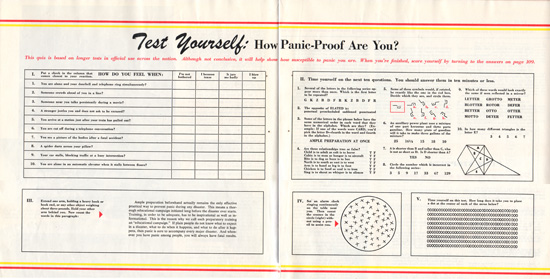
How Panic-Proof Are You?

This is the test I mentioned in the Friday conference, which was administered to determine how susceptible people were to panic in the event of a nuclear strike.

This how the test appeared in Collier's magazine:


But since this is totally illegible, you can take the test yourself on the PBS website: Panic Test

Seems like pretty blatant indoctrination to me. Interesting how the image in the red square strongly resembles a sickle. Still, I am extremely proud to say that I am "panic-resistant."

Sunday, 11 November 2012

Twilight Zone Pilot Introduction - 1959


For those of you who were at the screening Friday, this is the intro to the pilot episode that I was talking about (on my downloaded version, it was included with the ep., didn't realize it wasn't there on the DVD). Anyway, I think this is a really interesting glimpse at the way that Serling marketed the show to advertisers. It also gives us a good idea of what Serling was trying to achieve with the series. Give it a watch!

Friday Conference Artifact: Martians and the Cold War

For my artifact, I will present a 1956 cartoon called Destination Earth. It is a promotional cartoon sponsored by the American Petroleum Institute. 


      We follow the adventures of a Martian explorer (Colonel Cosmic) sent on a mission to Earth to discover a better power source for the state limousine of the planet’s ruler. He will end up landing in the US and learn about the glorious benefits of oil and market competition. I think this cartoon might be interesting for two reasons:

          1) We can see the rise of films, series (see the Twilight Zone episodes we’ve watched on Friday) and cartoons about invaders from outer space as a telltale sign of the general feeling of fear of the American society in the 1950s concerning space travels (it was the beginning of the spatial conquest). 

            2) Destination Earth is also a good insight into the American society during the Cold War. We clearly understand in the cartoon that the planet Mars stands for the Soviet Union. The dictator “Ogg” is the leader of this authoritarian society and exerts tight social control over his people (we can also notice the very Stalinist mustache of Ogg!). There is a straight opposition between two different worlds (Mars/USSR vs. Earth/United States) with different economic and political models. The cartoon promotes the American model based on the free market economy. Indeed, the Martian explorer discovers the benefits of oil and market competition as the “secret” of the Unites States’ prosperity, and incidentally an opportunity to overthrow the dictatorship.  

Here are some questions:

Do you think the progressive knowledge about space travels has changed the way people understand and react to the sci-fi films and series about outer space worlds? Do you think people are more skeptical in front of such films and series today? If yes, what could have replaced the “alien fear” of the fifties? (maybe themes like the end of the world, the proliferation of diseases, natural disasters, or the recent success of stories about creatures like vampires).

Bonus: "Top 10 ways to survive an alien invasion, as taught to us by Hollywood": http://ca.askmen.com/top_10/entertainment/top-10-ways-to-survive-an-alien-invasion.html#ixzz2BxVl74WR