Although there had been experimentations and developments of
3D technologies in the silent film era, feature-length 3D films officially
appeared and gained public attention in 1952 with the release of Bwana Devil. The film industry had been
steadily losing its customers to television and desperately needed something
new and different to regain their audiences. Despite the expensive hardware
that 3D demanded and the time-consuming processes that were involved, the
motion picture industry released several 3D films between 1952 and 1953 that
proved successful and drew audiences away from their TV sets and back into
theatres. The first 3D films were generally B-movies featuring science-fiction
monsters, gore, action, adventure, foreign settings, and as one would expect, Vincent Price.


However, this success was short-lived - there was a
wide-range of difficulties that accompanied projecting 3D films (such as
synchronization issues, the requirement of multiple projectionists, audience
seating being limited to center aisles, etc.) and it was rare that a film made
it through an entire screening without something going wrong. Viewers often
complained of headaches and eyestrain after sitting through 3D movies and
as a result, the regular versions of films often had more viewers.
Despite 3D films’ general decline in popularity by the end
of 1953, a second wave of 3D films were released in the following few years and
even began to feature stars like Rita Hayworth, Dean Martin and Jerry Lewis.
Popular directors like Alfred Hitchcock and Howard Hawks tried out 3D technology
in their films as well. 3D cartoons gained some popularity (Caspar the Friendly Ghost and Popeye for example) and slapstick comedy
like The Three Stooges’ also became reinvigorated with the potentials of 3D
(imagine pies flying off the screen).


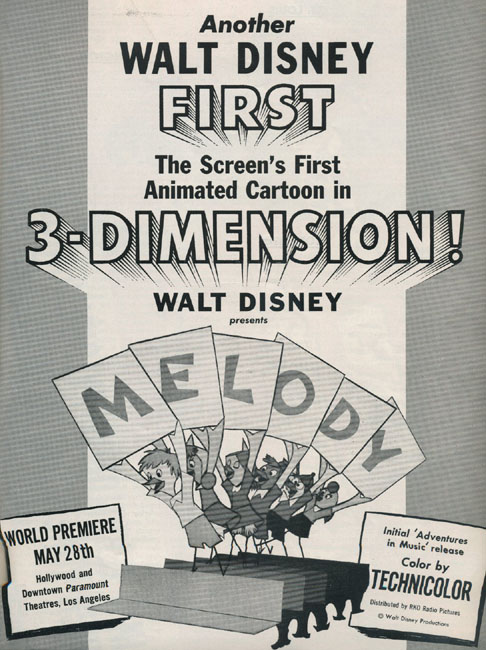

3D technology clearly functioned in the 1950s as a form of
spectacle. It revitalized the cinema-going experience and challenged the
dominance of television. Arguably the spectacular element of the ‘cinema of
attractions’ could be thought of as re-emerging with 3D in the 50s. The trailer
for House of Wax (1953) really plays
of this idea of spectacle and aesthetic pleasure; note how plot and characters
are relatively ignored while the awesomeness of 3D technology is brought up
again and again.
So just to think about:
-what potential effects does the emergence of new
technologies have on narrative? Do narrative and character development lose their
importance when special effects (like 3D) are involved?
-while television represented an at-home comfort and
convenience for 1950s consumers, 3D film represented a dramatically different
type of entertainment experience. What meanings can be drawn from the
contrasting qualities of these forms? Did television still ‘win’?
-has 3D’s popularity come in waves or is it now a norm? Is
3D still the thrilling experience it used to be advertised as? (take a look at
how the 1950s posters advertised it compared to today’s)
-how is the theatre space represented in the advertisement for House of Wax? How can we think about 3D's 'entry' into our personal space?